

How to write an artist’s statement
A short, clear statement that tells us about your art — how to write one that works.

What is an artist’s statement?
An artist’s statement is a brief statement which tells audiences about your art. It clarifies and adds to what the viewer can already see (or hear or feel, depending on the type of work you are making).
An artist’s statement:
- Is about your art, not so much about you
- Explains your process, materials and concepts and how these inform each other to create meaning in your work
- Is primarily about the work you are presenting now, or the current direction of your work, not a detailed history of how you got to this point
- Should be approximately 100–150 words
- Should use simple, jargon-free language
Artist’s statement or artist’s biography?
An artist’s statement is different to an artist’s biography (or bio). A bio is more generally about your education, exhibiting history and the personal and professional experiences which have shaped your art.
For the Queensland Regional Art Awards (QRAA), we ask you for an artist’s statement rather than an artist’s biography. If you are submitting more than one entry to the QRAA, you will need to supply an artist’s statement for each artwork.
Writing your statement
Writing an artist’s statement means understanding your own practice well. The following questions may help:
- What materials did you use to make this artwork? Why?
- What processes and techniques did you use? Why?
- Did you undertake any special research to produce this work?
- What subjects or themes do you generally explore in your work? Why?
- Who or what inspires you?
- Why do you make art?
- What are the questions you are trying to ask or answer in your work?
Use a mind map or dot points to respond to the questions most relevant to you, then start writing. If you get stuck, write disconnected sentences and worry about joining them up later — then edit, edit, edit. Use clear, simple language and check your spelling, grammar and punctuation. Write for an “educated generalist” — someone who doesn’t know much about art. Be descriptive but be direct.
Example: Alison McDonald, winner of the 2025 Art for Life Award
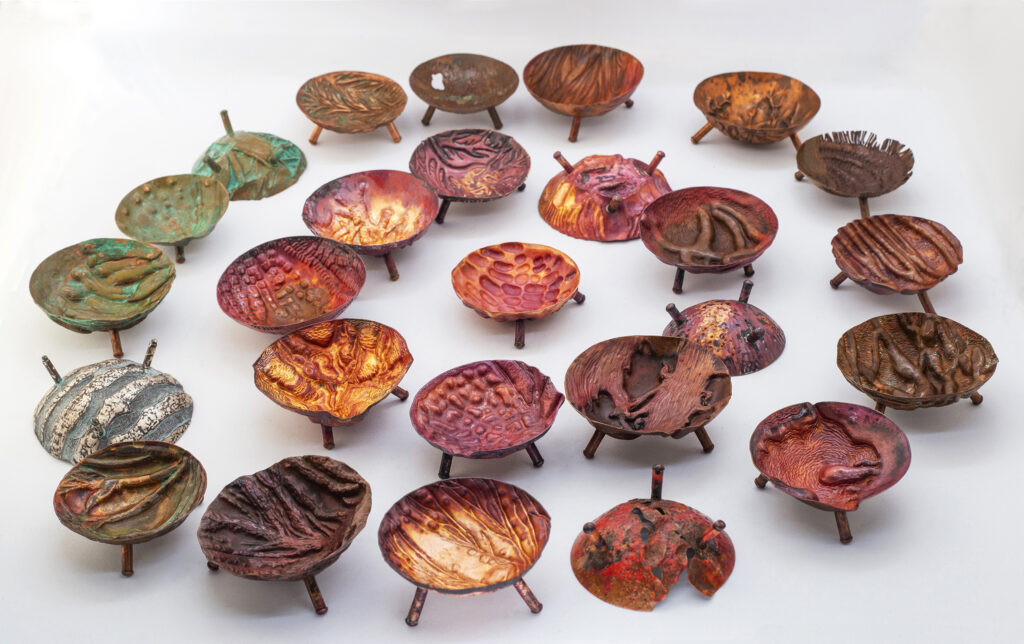
Alison McDonald, For Annie Slade, 2025
This dual landscape represents the intersections of my enduring passions: a fascination with seaweed and the technique of chasing and repoussé. Whilst giving momentum to an ancient technique, these diverge from traditional perfection, embracing the irregularities that arise during the making. Creation is slow and contrasting to the relentless pace of our contemporary world. Every mark a quiet celebration, with momentum driving the rhythmic tapping of the hammer against copper. This meditative act is gradual, each stroke building upon the last, transforming the material into something new. Connecting to Annie Slade’s 1884 collection (the British Marine Algae Collection at JCU Special Collections), sparked a creative dialogue leading to the development of these bowls. Studying her pressed seaweed specimens deepened my understanding of both her pioneering work and the enormous variety of marine algae. These bowls reference the undervalued global significance of seaweed as a cultural, ecological and food resource.
Why this works
- It opens directly, explaining the artist’s interests as they relate to the work
- It connects technique to meaning — how the process shapes how the work looks
- It highlights process and materials: embracing irregularities, working slowly
- It references important research and source material
- It closes by summarising the work’s key themes and conceptual driving force
- At 149 words, it is neither too long nor too short, and includes very little material about the artist personally — only what is relevant to the artwork