
Overview
It is often your responsibility to pack your artwork if it is sold or included in an exhibition such as the Queensland Regional Art Awards.
The following gives some tips for packing your work securely to help protect it against shock, movement and damage during freighting.
Please note that this guide is not an exhaustive source of information; artwork packing can be complex and sometimes costly, especially if the work is three-dimensional, very large, fragile, or travelling long distances. If so, you may wish to consult with a professional art packing or art transport service. Some of these services can also create bespoke packing for you. This, too, can be costly, so ensure you get quotes.
However, packing artworks need not always be expensive. It’s best to research the materials you are planning to use or buy to make sure that they are appropriate for the job and that you are getting a good deal. Sometimes you can even reuse materials, provided they are clean, dry and pest-free.
At Flying Arts, we will return your artwork to you or your buyer, if sold, in the packaging in which it was sent.

Paintings and Framed Artworks
These can be “soft-packed”, which means using layers of soft materials, rather than a box or a crate. Paintings should be packed using acid-free (pH neutral) materials such as soft, tissue-type paper or glassine, with bubble wrap on the outside.
Always remember: if using bubble wrap, ensure that the flat side of the bubble wrap is against the painting, NOT the bubble side, as this can damage the surface of the painting.
Be sure to give further support to weak points such as the corners of the artwork. You can purchase pre-made “corner supports” but you can also make your own.
Works on Paper
Paper works can rolled and placed into a strong tube in between layers of acid free tissue paper or glassine. Both ends of the tube (inside) should be protected with bubble wrap or a soft material. Be sure to securely tape the lids on both ends of the tube.
If the work is small, it could be laid flat inside an acid-free plastic sleeve (e.g. Mylar or Melinex polyester) before packing between two pieces of strong cardboard. The plastic sleeve must be taped down so that it doesn’t move inside the cardboard.
Take extra care if your medium is pastel or charcoal; consider a layer of glassine to prevent the medium from rubbing or transferring onto outer surfaces.
3D Works
These should be supported with padding in a box or crate strong enough to hold them in place. Make sure your work is:
- protected against shock and knocks
- cannot move around inside the box/crate
- kept clean, dry and insect-free
- easy to handle (for example, if the work is heavy to lift, the box or crate should have handles)
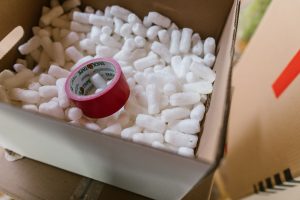
It is best to soft-pack 3D artworks before they go into the box. Pay special attention to any particularly fragile areas. Then, create padding so that the artwork does not move around in the box. Scrunched-up bubble wrap and packing “peanuts” are often suitable materials for padding.

Labelling your work
Clearly label the outside of the packing with the following details:
- Your name, title of the artwork, date, medium, dimensions
- Address where the work is coming from
- Address where the work is going to
- A small image of the artwork that is on the inside of the packing
Rather than hand-writing the above details, it is often better to attach a typed sheet of paper inside a waterproof sleeve, securely taped in several places to the outside of the packing.
Additionally
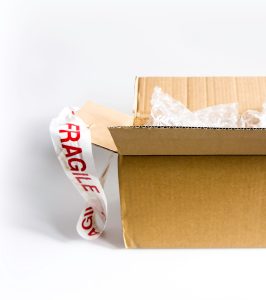
- Indicate that the artwork is “fragile”. You can purchase tape that says “fragile” on it, or write the word in large, bold letters on the packing
- Indicate which is the top of the packing by using arrows or writing “top” on the topmost part of the packing
Useful videos:
How to pack and ship in paintings professionally – Complete step-by-step guide, by Contemporary Art Issue
How to safely pack paintings for shipping, by Agora Gallery
How to pack ceramic sculpture for shipping, by Martin Harman Art